
T H E A R T I S T
Khadija Elabid Bashllari
C O N T A C T
Some things find you at exactly the right moment.
For Khadija Elabid Bashllari, painting was one of those things. Not a sudden discovery, but a return.
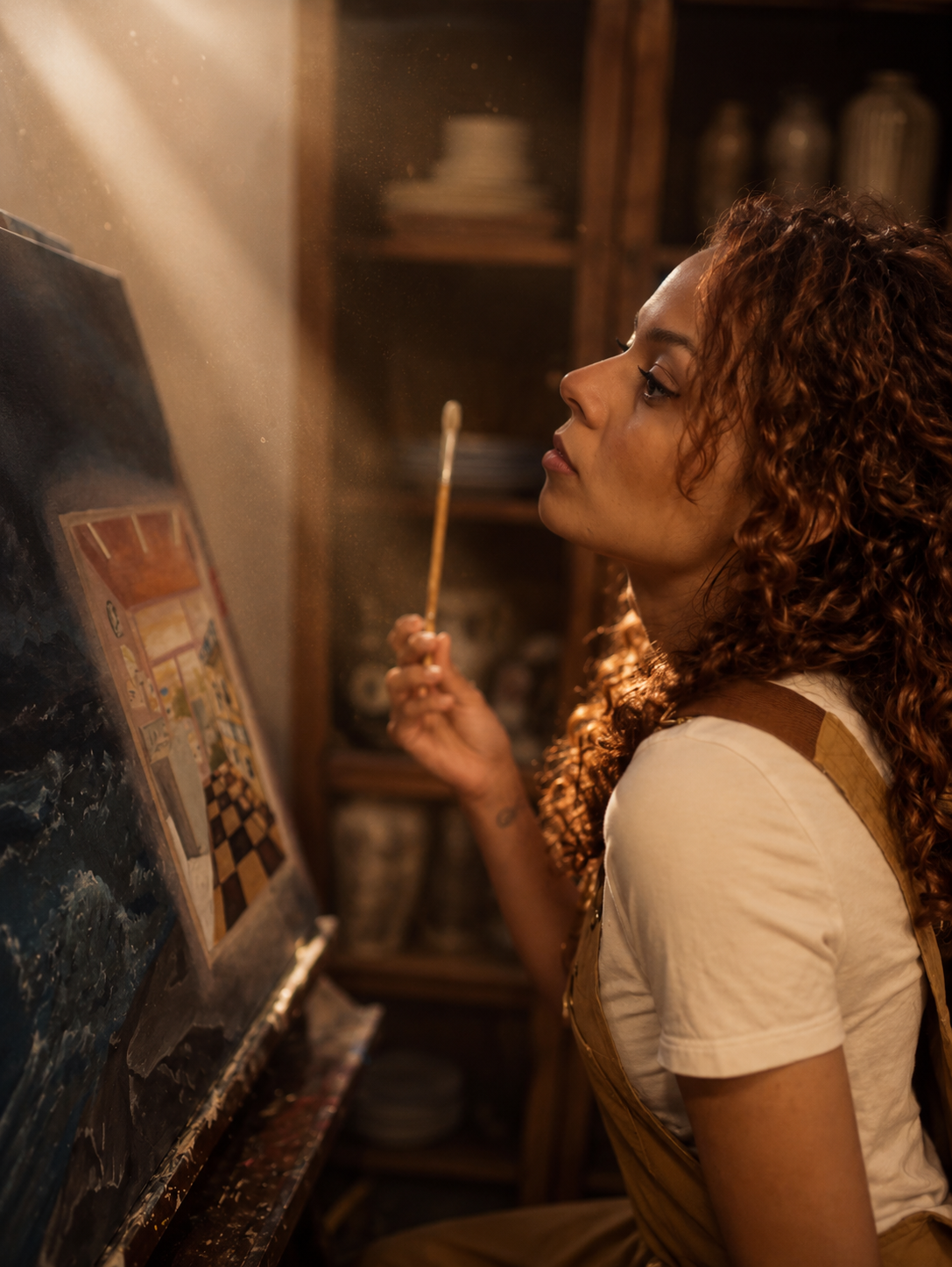
Growing up, she watched her father paint in the backyard of their home in France. She was around seven years old. It was spring, and she remembers the light the way you remember things that matter before you know they matter. The smell of cut grass drifting in, her father's back turned to the house as he worked, unhurried, as if time had agreed to leave him alone for a while. He painted other worlds: landscapes that didn't exist on any map, places that felt more real than the street outside. She would sit nearby, quietly watching, and feel something she couldn't name. Only later would she understand it was peace.
He always gave his paintings away. Every single one. At the time, she didn't understand it. How you could create something like that and then simply let it go. Now she does.
In August 2025, everything changed. Khadija suffered an Amniotic Fluid Embolism with a sudden cardiac arrest. For six minutes, she was gone. Many women who survive what she survived lose memories, capacities, pieces of themselves. Khadija was fortunate, she kept her mind. But she came back different. The things she had always planned to do "someday" were no longer waiting patiently. They had become urgent. They had become now.
The Thresholds Trilogy
Working in oil on canvas, Khadija builds large-scale conceptual works that sit at the threshold of two worlds: the urban and the natural, the familiar and the wild, the life we are living and the life we imagine when we stare out windows. Her trilogy, Thresholds, follows a single question across three bodies of work: what do we actually long for, and what does that longing cost us?
The first series draws from the oldest images in human memory, the burning bush, the parted sea, the edge of revelation. These are not landscapes. They are encounters with something sacred and overwhelming.
The Way Out finds nature already here, erupting through the wall of the office, blooming in the emergency door of a school bus, waiting behind the EXIT sign at the arcade. We are not trapped. The door has always been open.
The Return is the honest answer to what lies on the other side: sometimes the most peaceful place in the world is not the one we would expect… the laundromat at dusk, with the sunset bleeding warm light through the window, and nowhere else to be.
Like her father, Khadija paints for others. Every painting she finishes belongs somewhere, to someone who will feel less alone because of it. Art, she believes, finds who it belongs to. Her father gave his work away freely, and for years she mourned that there were no paintings left, no physical memory of all those quiet afternoons in the garden. Now she understands. They were never lost. They were exactly where they needed to be.
This is her first collection.